Consumer brand · D2C
Deadbear
Performance marketing and measurement for a direct-to-consumer brand.
- Performance Marketing
- Measurement

- 86%Of the prior month's revenuebooked in 3 days · Vault Sale, Oct 1–3 2026
- 3.1×Daily revenue run-ratesale window Oct 1–9 vs the Sep 2026 daily average
- 11×Peak sale dayan average day's store revenue · Oct 2026
Figures from the client’s order system and ad platforms, shared with permission.
The work
The challenge
A growing direct-to-consumer brand with spend spread across Meta and Google, and three different numbers for what that spend returned: one from each platform and one from the store.
What we did
We rebuilt the account around the store's revenue. Spend is read from the platforms, revenue from the order system, and the one figure the brand runs on is revenue over total spend. Campaigns were restructured by product line, with budgets moved to the lines the store confirmed were working.
What changed
One monthly report, one number the founders trust, and budget decisions made on what the store books rather than what the platforms claim.
Inside the engagement
Three numbers, one store
When we took over the account, Meta reported one revenue figure, Google another, and Shopify — the system that actually collects the money — a third. All three were presented as 'results'. None of them agreed, so none of them could be trusted for a budget decision.
The first month was spent building a single source of truth: a daily tracker where every rupee of spend is read from the ad platforms' own APIs and revenue comes only from Shopify. Meta and Google rows carry spend, impressions and clicks; revenue exists in exactly one place. The return the brand runs on is MER — store revenue divided by total ad spend — and nothing else is called revenue.
Structure: one ad set per product, one card per variant
The account was rebuilt around the catalogue. Each product line gets its own ad set with its own budget, so spend per line is a deliberate decision rather than an algorithm's accident. Carousel ads are built one card per colourway, and every card links to that variant's own product page with its own tracking tag — so the tracker shows not just which ad worked, but which product on which card.
Every destination URL carries a full UTM convention down to the individual creative. When a product sells, the order can be traced back through Shopify to the exact card someone tapped.
The shoot strategy: catalogue discipline, street-brand energy
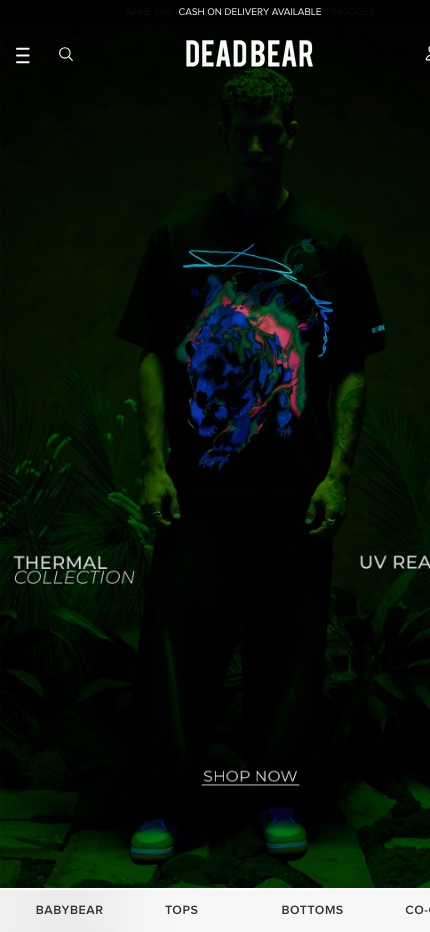
Deadbear's creative is shot like a catalogue and cut like content. Products are photographed at full resolution in square crops for feed carousels, with separate 9:16 vertical frames prepared for Stories and Reels placements rather than letting the platform crop a square badly.
Copy names the product and the fabric instead of shouting. Delivery runs broad with a premium-interest layer, letting the creative do the targeting — which is also exactly the direction Meta's own delivery system has moved.
The Vault Sale: 86% of a month in three days
In October 2026 the brand ran a three-day, sitewide Vault Sale. Rather than inventing a new structure, we duplicated the campaign skeleton that had already proven itself in the previous festive season, pointed it at a broad audience, and gave it four distinct creative routes plus a cart-threshold bonus to lift order values.
The three days of the sale booked 86% of the entire previous month's store revenue. Across the sale window — October 1 to 9 — daily revenue ran at roughly three times the previous month's average, and return per rupee of spend came in at nearly three times the previous month's level. Sale windows are not evergreen economics, which is why the spike is always reported next to the baseline instead of being allowed to speak for the year.
Questions about this work
What is MER and why is it the headline number?
MER (marketing efficiency ratio) is store revenue divided by total ad spend, across all platforms. Spend is read from the ad platforms, revenue only from Shopify. Unlike platform ROAS, it cannot double-count an order that two platforms both claim.
Was the sale window really that efficient?
Yes — return per rupee of ad spend across the sale window ran at nearly three times the account's evergreen level the month before. But sale economics are not evergreen economics, so the spike is reported next to the baseline, never instead of it. Exact return figures are shared with prospective clients on request.
What made the Vault Sale work?
A hard three-day window, a sitewide offer simple enough to say in one line, a campaign structure duplicated from one that had already proven itself, a cart-threshold bonus to lift order values, and broad delivery with four distinct creative routes.
Why one card per product variant?
Because it turns a carousel into measurement. Each card links to its own product page with its own tracking tag, so the brand can see which product on which card produced the order — not just which ad.
Let's make
your mark.
Tell us about your brand and where you want it to be. We will come back with a plan, not a pitch.
Start a conversation